INShAck 2019 — You Shall Not Pass (Forensics 330)
Extract a hidden port-knocking sequence from an NTFS filesystem image, then implement the knock sequence in Python to unlock a flag service.
Data extraction from an NTFS image, base64/gzip decoding, and implementing a custom port-knocking sequence in Python.
Challenge Details
Category: Forensics | Points: 330 | Solves: 11
One of my friends is a show-off and I don’t like that. Help me find the backdoor he just boasted about! You’ll find an image of his USB key here.
Phase 1: Data Extraction from NTFS Image
Mount the NTFS image:
file dd.img
sudo mkdir -p /mnt/you_shall_not_pass
sudo mount -o loop -t ntfs dd.img /mnt/you_shall_not_pass
The filesystem contains random text files (Bacon Ipsum) and an LOTR MP4. Hidden data isn’t in the normal files.
Finding the Hidden Data
Running tail on the raw image file reveals something suspicious at the end — a Base64 string:
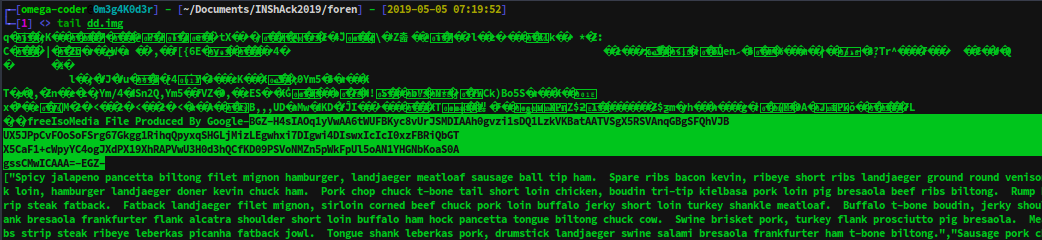
The H4sI header is the gzip magic bytes in base64.
Decoding
echo "H4sIAOq1yVwAA..." | base64 -d > file.gz
gunzip file.gz
cat file.tar  # Not actually a tar, just JSON
The JSON reveals a port-knocking configuration:
{
    "door": 20000,
    "sequence": [
        {"port": 10010, "proto": "UDP"},
        {"port": 10090, "proto": "UDP"},
        {"port": 10020, "proto": "TCP"},
        ...
    ],
    "open_sesame": "GIMME THE FLAG PLZ...",
    "seq_interval": 10,
    "door_interval": 5
}
Phase 2: Port Knocking Implementation
Port knocking opens firewall ports by sending packets to a specific sequence of closed ports. After the correct sequence, port 20000 opens.
#!/usr/bin/env python3

import time
import socket
import select
import json

class Knocker:
    def __init__(self, ports_proto, delay=400, host="127.0.0.1", timeout=200):
        self.timeout = timeout / 1000
        self.delay = delay / 1000
        self.ports_proto = ports_proto
        info = socket.getaddrinfo(host=host, port=None, flags=socket.AI_ADDRCONFIG)[0]
        self.address_family = info[0]
        self.ip_address = info[4][0]

    def knock_it(self):
        for i, port_spec in enumerate(self.ports_proto):
            port, proto = port_spec.split(':')
            use_udp = (proto == 'UDP')

            s = socket.socket(
                self.address_family,
                socket.SOCK_DGRAM if use_udp else socket.SOCK_STREAM
            )
            s.setblocking(False)
            addr = (self.ip_address, int(port))

            if use_udp:
                print(f"  [UDP] Knocking {port}")
                s.sendto(b'', addr)
            else:
                print(f"  [TCP] Knocking {port}")
                s.connect_ex(addr)
                select.select([s], [s], [s], self.timeout)

            s.close()
            if i < len(self.ports_proto) - 1:
                time.sleep(self.delay)


if __name__ == '__main__':
    host = "you-shall-not-pass.ctf.insecurity-insa.fr"

    with open("file.tar") as f:
        data = json.load(f)

    ports_proto = [f"{p['port']}:{p['proto']}" for p in data["sequence"]]

    print("[*] Knocking sequence...")
    Knocker(ports_proto, delay=900, host=host).knock_it()

    time.sleep(1)
    print("[*] Connecting to door...")

    try:
        s = socket.socket(socket.AF_INET, socket.SOCK_STREAM)
        s.connect((host, data["door"]))
        s.send(data["open_sesame"].encode())
        flag = s.recv(1024).decode()
        print(f"[+] FLAG: {flag}")
    finally:
        s.close()
Flag: INSA{213dca08e606ef9e5352f4bdd8b6dd9d6c559e9ce76b674ae3739a34c5c3be37}
Key Takeaways
- NTFS slack space and filesystem tails can hide data invisible to normal directory listings
- Port knocking is a legitimate security technique — detecting it requires full packet capture analysis
- Always check raw binary files with
tail,strings, andbinwalk— hidden data often lives outside the filesystem structure - The
base64 | gzipcombo is a classic CTF data encoding pattern